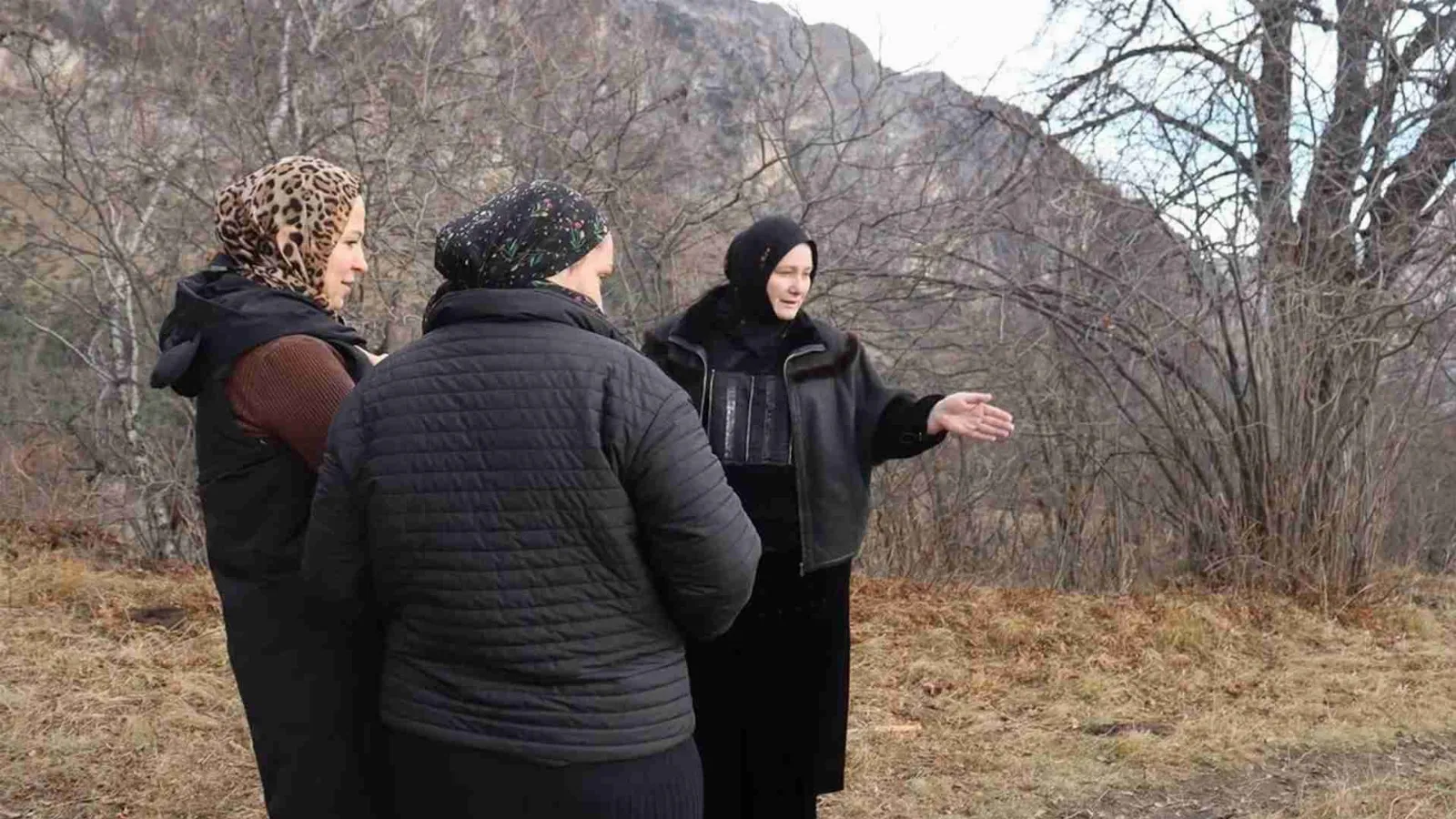
Abdulatip Ashibov is a well-known Dagestani artist and a member of the Union of Artists of Russia. His work focuses on landscapes and still lifes inspired by observations of his homeland. His paintings depict an old village, the Tarkho River, red rooftops, and autumn slopes. He does not aim to turn his native places into a typical postcard but tries to convey a special state of nature, a sense of calm, and the play of light. Viewers, looking at his canvases, seem to momentarily disconnect from the noise of the city and are transported to the mountains.
The artist's home studio houses works painted in oil. Landscape painting requires speed, as the artist must capture the changing light and mood of nature. Still lifes are created differently — one can return to them for months, refining details. The paintings feature ordinary items of rural life: fruits, dried meat, fat-tail sheep fat, and jugs. In these objects, Ashibov sees memories of family and traditions. His work resonates with poetry, where images of a dagger, a pandur, and antique tableware often appear.
The artist's path into art began not with exhibitions but with his work as a projectionist in the 1970s. Later, he studied in Makhachkala and then received an offer from the chief artist of the Leningrad Theatre, becoming an auditor at the Academy of Arts. Returning to Dagestan, Ashibov worked for a long time in the education sector, giving children the opportunity to see the world more broadly. In the 2000s, he also participated in the construction of a bridge over the Tarkho River and the Zagorsky Hydroelectric Power Station. His poems, written in the Akhvakh and Avar languages, are often translated into Russian.
Since 2018, the artist has lived in Makhachkala, which facilitates his participation in exhibitions and communication with colleagues. During the day, he teaches, and at night, he paints. Ashibov does not chase awards, creating works for his soul and for children. His canvases are kept in private collections, where each painting has its own story. This year, the artist turns 70, and his work continues to serve the preservation of cultural heritage.